
I have been working professionally for nearly four decades, and in my experience strategy is a term often thrown around casually and often incorrectly. Since this post is about strategy, let's define Strategy as a set of integrated choices designed to gain or maintain a competitive advantage relative to your competition. Artificial Intelligence (AI) continues to evolve incredibly fast and organizations are struggling to effectively integrate AI into business operations in order to achieve desired outcomes. Even sophisticated organizations often fall into the trap of starting strategy discussions with one or more AI tools such as Microsoft Copilot, Claude, ChatGPT Enterprise, etc. I call this a trap because allowing short-term tactical decisions to drive strategy rarely leads to desired outcomes.
That is understandable. The tools are impressive, the pace of change is incredibly fast, and there are legitimate concerns about the risks of being left behind. However, a tool-first AI strategy inevitably leads to a collection of competing tools and a lack of standard processes that can seize up organizational gears and result in chaos. As I like to say, if you don't know where you're going any road will get you there.
Start With Business Outcomes
An effective AI strategy, really any strategy, addresses business goals, objectives, and targeted outcomes. There is nothing wrong with experimenting, and experimentation is absolutely part of the path, but the strategy itself needs to be anchored to business strategies in order to minimize strategic drift.
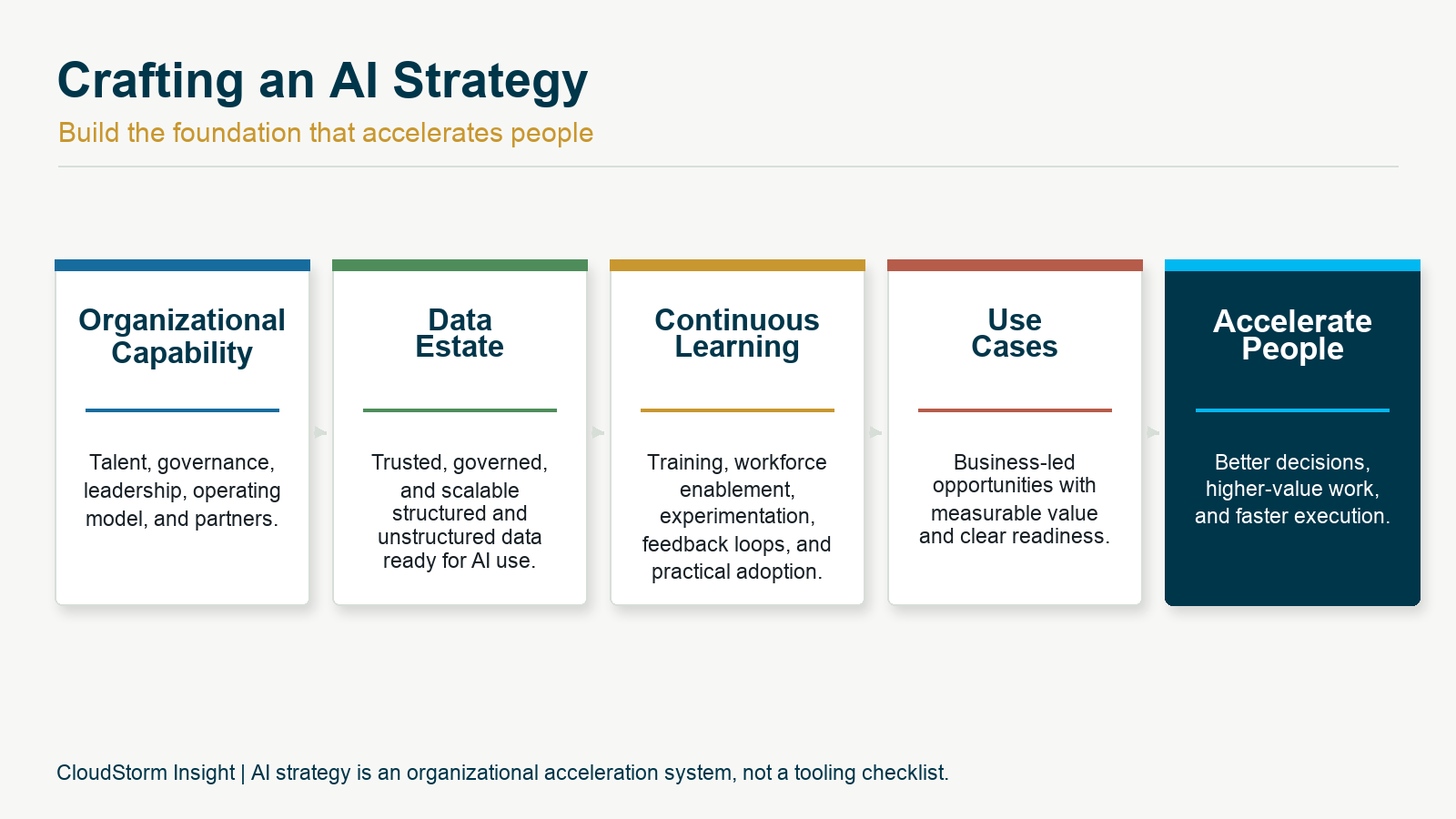
At CloudStorm, we think about AI strategy as an organizational acceleration system. The technology matters, but the real test is whether people are able to make better decisions, complete higher-value work, and move faster with greater confidence. A successful AI strategy should drive meaningful and demonstrable change that clearly positions AI as a force multiplier for human potential.
The first questions shouldn't be "Where can we use AI?," "Is Claude Code better than Codex?," "Should we subscribe to multiple AI services?," etc.
The better question is, "What business outcomes are we trying to improve, and where can AI help people produce those outcomes faster, better, or more consistently?"
That distinction matters. If the conversation starts with AI, almost anything can sound like a use case. If the conversation starts with business outcomes, leaders are forced to define value. Are we trying to reduce cycle time? Improve customer service? Increase forecast accuracy? Protect institutional knowledge? Reduce manual effort? Improve decision quality? Create new revenue opportunities?
Those questions keep the strategy grounded. AI can be applied in many places, but organizations shouldn't allow bright shiny objects (i.e. lower value AI use cases) to distract from initiatives that really move the needle.
The Foundational AI Path
Developing and implementing the right AI strategy is a daunting proposition. AI technologies continue to evolve at a pace that is extremely difficult for anyone to keep up with. Over the past several years we have developed a framework for developing and implementing effective AI strategies that define the foundational work required to use AI in a way that creates measurable business value and accelerates people. We organize AI strategies around four foundational strategic elements that mutually support one another in order to achieve the outcome of accelerating people to a degree unattainable without AI.
The foundational elements are intentionally broad, and they need to be addressed in parallel. Organizational Capability, Data Estate, Continuous Learning, and Use Cases are described below as a comprehensive operating view, not as a serial checklist. The pace of change is so rapid that organizations unable to respond rapidly to multiple needs will be left behind.
Organizational Capability
AI requires organizational capability, not just technical capability. This includes leadership alignment, governance, data and analytics talent, security and risk management, delivery capacity, change management, and a clear operating model. It is easy to underestimate the support infrastructure required to design, implement, scale, and govern an AI program. Below are some key lessons learned over the past several years; these are not unique to AI but they are exacerbated by AI given the rush many organizations are making to embrace AI technologies.
-
AI Governance: Organizations need to define how they are going to integrate AI into business operations. This can be done using a variety of design models such as centralized control managed by a Chief AI Officer (or some other title), use of an AI Lead Team for governance/steering purposes, or more decentralized control mechanisms with "AI Champions" embedded within business units.
-
AI Use Case Intake and Prioritization: I have observed organizations that struggle mightily to even get out of the gate. It's a little like watching the start of a marathon when the gun goes off and runners scatter in all directions because they don't know the course layout. The point is there needs to be an intake mechanism to collect, vet, and prioritize AI use cases. Preferably the tool or system of choice is not Excel. Using tools like Excel complicates the task because there are inevitably different copies stored in multiple locations which leads to significant drift, use cases will be of varying quality...and many won't be legitimate AI use cases at all...and if sunlight is the best disinfectant then keeping use cases in a document keeps them in the dark. The best solution is to have an agile solution available to all users for visibility. One successful model we have deployed is the creation of a custom AI Hub to centrally manage and provide visibility to governed AI capabilities with integrations to Project Management Office (PMO) software to manage ongoing development and change management processes.
-
Operating Model: Leaders need to decide how permissive or restrictive they want to be regarding access and use of AI within their organizations. It seems many companies have strict controls in place for key business processes, but when it comes to AI it's virtually anything goes. Leaders need to understand that AI can be a true force multiplier for employees, but unrestricted or ungoverned use of AI can introduce major risks including security, legal, technical debt, policy violations, data leakage, and many other issues. My preferred model is to provide users with a sandbox where they can leverage AI tools for personal or team use and to bring broader AI capabilities under formal governance to manage the lifecycle of AI capabilities from inception to eventual retirement. The former allows individual users to have their own personal expert assistant while the latter ensures appropriate governance, security, and compliance with applicable policies.
Data Estate
If organizational capability is the human side of the strategy, the data estate is the foundation the technology stands on. AI systems are only as useful as the information they can access, understand, and trust. I often recommend organizations start with the data estate pillar when they are struggling to chart a path forward with respect to their AI strategy because this area is more technical in nature and has longer lead times. In many organizations, structured data is fragmented across core systems, spreadsheets, reporting tools, and departmental databases. Unstructured (e.g. PDFs, images, etc.) data is even harder because it is trapped in documents, shared drives, PDFs, and knowledge repositories that are not searchable by traditional SQL or other query techniques. However, an estimated 90% of all corporate data is unstructured so there are powerful incentives for organizations to unlock the power of unstructured data in order to gain key insights into this powerful source of untapped data potential.
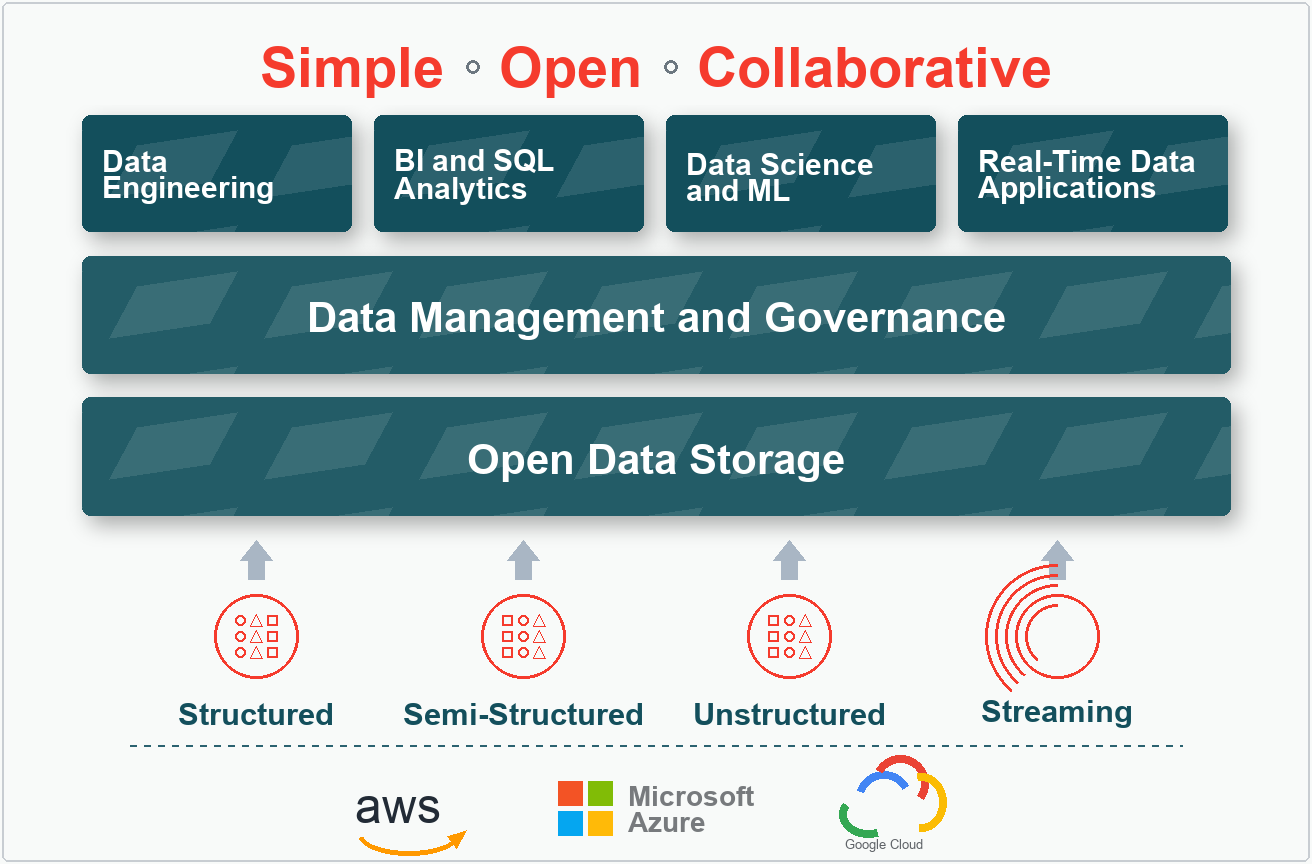
The Data Estate foundational element is broad and deep, so the goal is to identify the strategic choices that matter most. Below are some high-level thoughts on creating the Data Estate component of your organization's AI strategy:
-
Inventory and document key enterprise-level data sources.
-
Choose the right data warehouse, or if your organization can afford it and has the business needs, the right data lake. I have implemented Databricks at scale building robust data pipelines for both structured and unstructured data. Think of a data pipeline like a hose. Have you ever connected a hose to a water spigot and then watched water drip or spray out from an imperfect connection to the spigot? That's comparable to data loss from a poorly designed data pipeline. Data pipelines need to be tight (i.e. no leakage), monitored, observable, and data lineage should be a key consideration. Leading platforms such as Databricks provide these tools and others including governance, security, and much more.
-
Unstructured data stored in a data lake needs to be parsed and stored in a vector database where it can be retrieved using techniques such as cosine similarity search. It is important to carefully think through the parsing strategy, metadata, and storing the generated vectors in a vector database. A very common AI pattern is Retrieval Augmented Generation (RAG), where AI applications accept a user prompt, perform a search against a data store, return relevant results, pass updated context into a large language model (LLM) such as Claude, ChatGPT, Gemini, etc., and then return the final response to a user.
-
Don't ignore the Fin in FinOps which is short for Financial Operations. Too many organizations focus on building out the operational side of their data estate, but costs can rapidly escalate from compute costs required to support increasing data pipelines, surging user demand, new AI applications, and more. Careful thought must be given to how compute resources are scaled and managed, how often to refresh data lake environments (e.g. dev, stage, prod, etc.), and the timing of data pipeline movements. For example, it's much more expensive to keep an external system in near real-time sync with the data lake versus refreshing once a day.
This is why a serious AI strategy almost always becomes a serious data strategy. A governed data lake or lakehouse architecture, reliable ingestion pipelines, catalogs, lineage, quality controls, access policies, and cost management are not side projects. They are AI enablers.
You can certainly run isolated AI experiments without that foundation. You just cannot scale them very well.
Continuous Learning
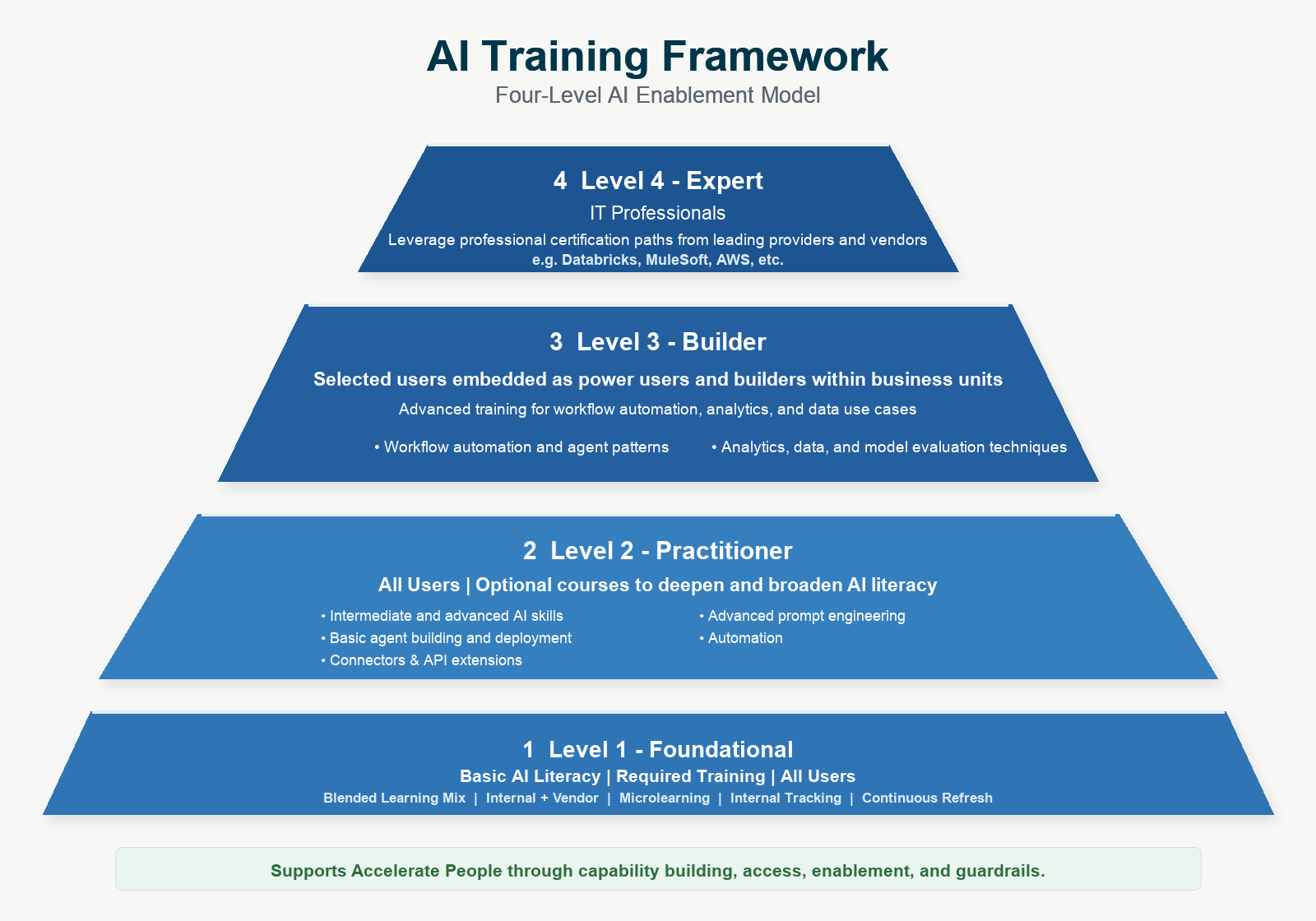
AI is moving too quickly for one-time training to be sufficient. Organizations need a workforce enablement framework that moves employees from required AI literacy to deeper technical expertise in a deliberate, measurable way while maintaining fresh and current content, which requires superior agility. My personal observation is the vast majority of organizations struggle to deploy a consistently refreshed workforce enablement/training program. For mid-size to large organizations I recommend the following four levels:
-
Level 1 - Foundational: This level of training should be mandatory for all users provided with basic AI capabilities to assist with the performance of their job responsibilities. I recommend this level of training be kept "skinny" and consist of basic essential courses, policy acknowledgements, and other material required to leverage AI tools and capabilities with minimum essential skills and in compliance with organizational policies.
-
Level 2 - Practitioner: This level allows AI users to explore areas where they have special needs, interests, or job-specific requirements for additional or more advanced AI training. The designed enablement program should provide users with an array of current and relevant AI courses to prevent AI skills from decaying or becoming less relevant in a rapidly changing world. Users who display intellectual curiosity and take advantage of current courses will likely stand out from peers who are less motivated.
-
Level 3 - Builder: IT resources in most organizations frequently don't have sufficient bandwidth to meet normal business IT demand, and AI is driving a massive backlog of IT demand for AI support. One way to mitigate IT capacity gaps is to train selected users as "Builders" who are trained in advanced AI capabilities, are embedded within business units, and coordinate closely with IT to design, deliver, and deploy new AI capabilities at the team and departmental levels. The IT Department provides advanced support, oversight, and governance while trained Builders significantly scale AI capacity.
-
Level 4 - Expert: Designing, implementing, and maintaining a high-quality AI workforce enablement program requires a substantial amount of organizational resourcing and commitment. Fortunately, there are a number of high-quality and well-regarded expert certifications available from premier companies such as Amazon Web Services (AWS), Salesforce/MuleSoft, Databricks, and others. IT departments should leverage these certifications wherever appropriate and not pursue their own internal training for platforms that support their AI environments (e.g. Databricks running on AWS) unless there are unique business requirements, and even then training should be narrow and focused to meet specific identified gaps.
The learning model should be blended. Internal business context matters because employees need to understand how AI applies to the way the organization actually works. External learning platforms add scale, structure, and depth. Microlearning keeps the program practical and helps drive sustained engagement rather than treating AI training as a one-time event.
Governance and tracking matter too. When training is managed through an enterprise learning system, the organization can institutionalize capability instead of depending on a few highly motivated AI leaders. That is the real goal of continuous learning: build distributed ownership, create practical guardrails, and help people keep improving as the technology changes.
Use Cases
Use cases are where strategy meets reality. This is also where a lot of AI enthusiasm gets humbled when wishful thinking runs into reality.
A useful AI use case needs a business problem, a clear objective, engaged stakeholders, clear process understanding, a data assessment, a path to pilot, and a realistic production model. Without those ingredients, the organization may still have an interesting idea, but it probably does not yet have an AI initiative...at least one ready that has a technical right to proceed.
Use cases should be evaluated based on business value and feasibility. Some ideas are ready for personal productivity tools. Some are better understood as team productivity opportunities, where reusable workflows or team agents can help groups of employees perform recurring work more consistently. Others are enterprise AI opportunities that cross functions, embed AI into operations, and require top-down prioritization because the work touches systems, data, governance, security, and change management.
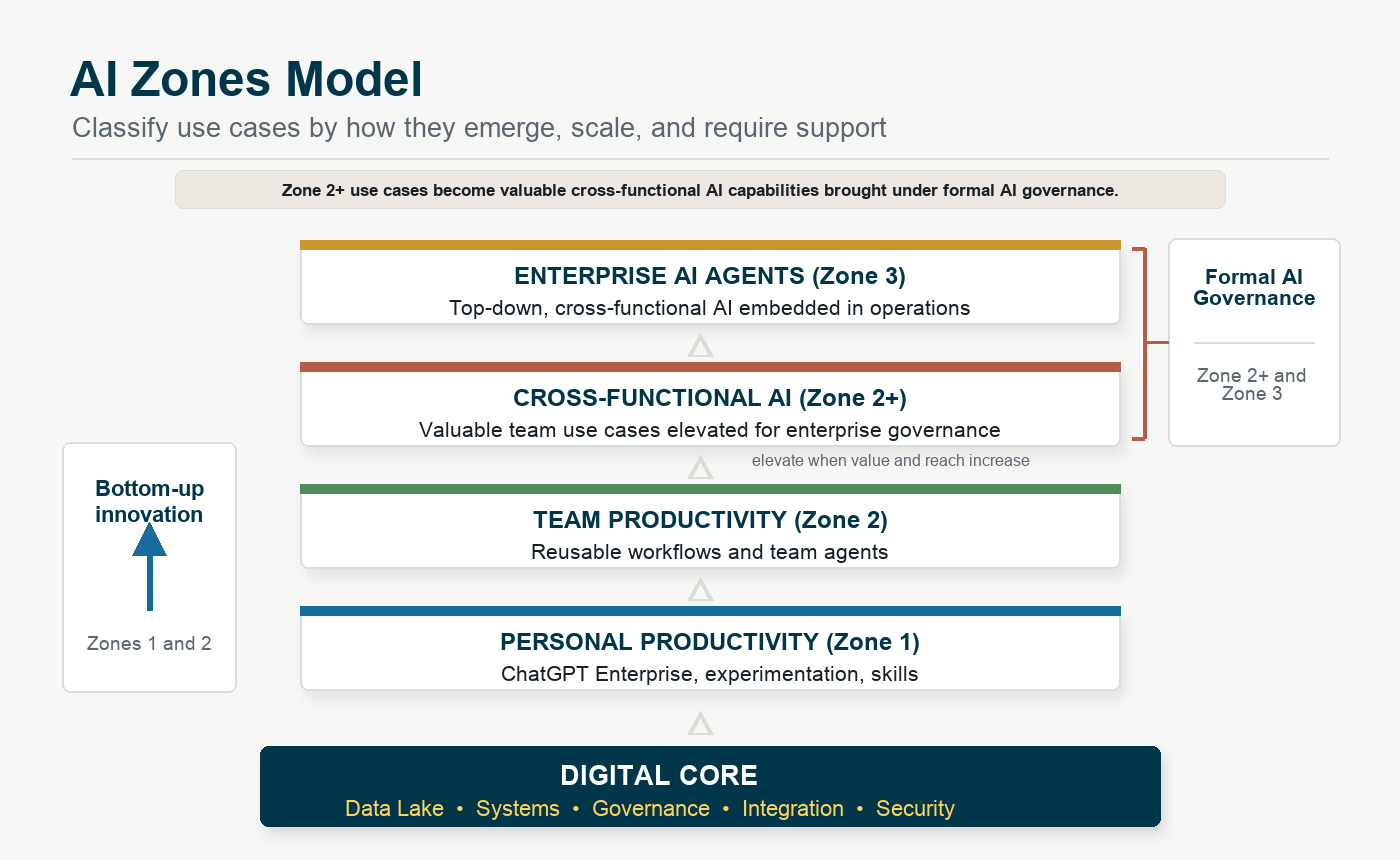
A useful way to classify use cases is to use an operating model we have developed over time that groups use cases into three zones. The first two zones are bottom-up driven, meaning use cases in these zones are grassroots efforts led by individuals or small teams. Zone 3 AI use cases are top-down driven, meaning they are designed to support larger enterprise initiatives.
-
Zone 1 - Personal/Team Productivity: Users are given the freedom to leverage AI tools to enhance personal productivity for themselves and small teams. A good example is a user given a license to ChatGPT Enterprise who can use ChatGPT to enter custom prompts, use connectors to various software suites (O365), or create personalized agents to perform routine tasks.
-
Zone 2 - Team Productivity: Reusable workflows and agents that can scale within a function or across related teams. Many business teams perform routine tasks that can be automated using agents which allows users to focus on more value-added tasks. This is the sweet spot for organizational builders. If sufficient value is present or significant IT involvement is required then zone 2 use cases may be classified as zone 2+ use cases which triggers tighter governance and additional controls.
-
Zone 3 - Enterprise AI: High-value, cross-functional capabilities that need executive sponsorship, technical delivery, and operational support. The biggest AI value drivers come from major corporate initiatives that often require major business process reengineering efforts which can trigger organizational design considerations. It is important to note that AI capabilities will play a supporting role throughout a major business process (e.g. order to cash). These use cases need to be prioritized, tracked, and managed closely in order to remain synchronized with overall corporate objectives.
The Intended Outcome: Accelerate People
The point of the foundational path is not to admire the foundation. The point is to accelerate people.
AI should help employees move faster from information to insight. It should reduce the time spent searching, summarizing, reconciling, drafting, reformatting, and repeating work that machines can help with. It should give people better context when they make decisions. It should help less experienced employees benefit from institutional knowledge that is often scattered across systems and documents. It should help experts spend more time applying judgment and less time digging for inputs.
This is why I prefer to position "accelerate people" as the outcome rather than as just another pillar. Organizational capability, data estate, continuous learning, and use cases all exist to make people more effective.
At the risk of starting a management consulting holy war, automation is not the whole story. AI can certainly automate tasks, and that matters. But the bigger opportunity is augmentation: helping people do work they already do, only with better leverage.
AI is a force multiplier for human potential when it is aimed at the right work and supported by the right foundation.
Execute in Parallel Streams
One common mistake is treating AI strategy like a long waterfall project. First we will create the strategy. Then we will build the data platform. Then we will train people. Then we will identify use cases. Then, eventually, we will create value.
That sounds orderly, but it is too slow...speed kills in this era...operating cycles that used to be measured in years are now months, and what used to take months is now taking weeks or even days.
The better approach is to execute in parallel streams. Build the data estate while developing targeted use cases. Train people while improving governance. Pilot practical solutions while measuring value. Update the strategy based on what the organization learns. The strategic foundational elements are different, but they are all mutually dependent on one another and need to be synchronized with consistent strategic choices.
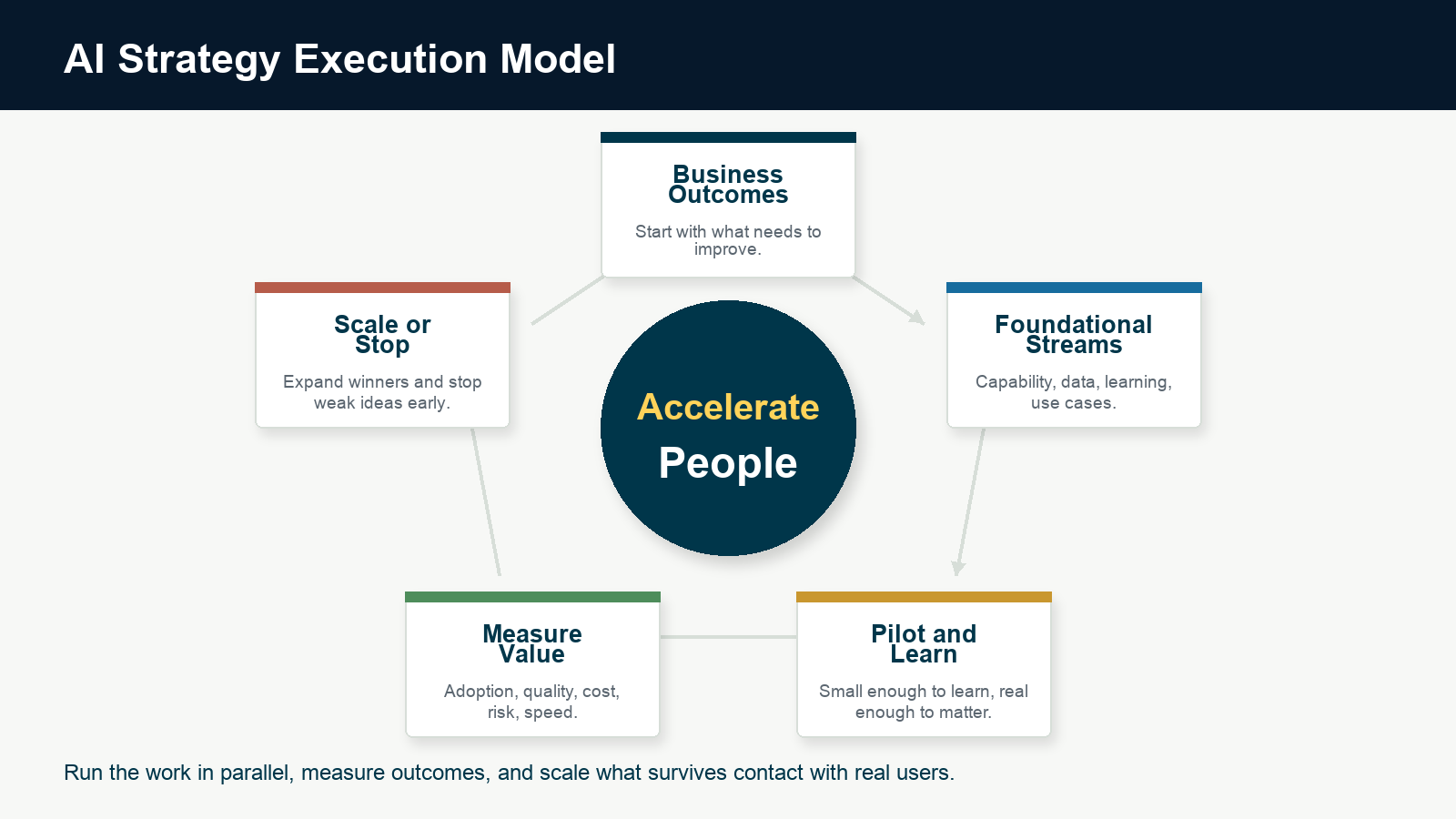
The key is to keep the work connected. Data investments should be informed by business use cases. Use case prioritization should consider data readiness. Training should reflect the tools and workflows employees will actually use. Governance should protect the organization without smothering experimentation.
This is also why metrics matter. AI strategy should include KPIs that help leaders understand adoption, quality, cost, risk, time savings, cycle time, customer impact, and business value. If a pilot cannot define what success looks like, that is usually a sign the use case needs more work.
Watch Outs
There are a few common AI pathologies worth avoiding.
-
Do not let tools masquerade as strategy. Buying AI tools may be necessary, but procurement is not transformation.
-
Do not build a data estate in isolation from business value. You can spend a lot of calories building a beautiful data platform before anyone can explain what business decision it improves. Use cases should help prioritize data work.
-
Do not confuse prototypes with production. A demo can be valuable, but production requires security, governance, monitoring, support, cost management, user adoption, and a clear owner.
-
Do not start too many proof of concepts without a path to scale. AI teams can become very busy proving that things are possible while the organization waits for something useful. A simple AI Zones model helps leaders distinguish individual experimentation, team productivity, and true enterprise capabilities.
-
Do not underestimate change management. AI adoption is not just a technical rollout. People need to understand when to use AI, when not to use it, how to validate outputs, how to protect data, and how their work is expected to change.
TL/DR
-
An AI strategy should start with business outcomes and end with people acceleration.
-
Organizational capability, data estate, continuous learning, and use cases are the foundational elements that make AI useful and scalable.
-
AI Zones help leaders separate personal productivity, team productivity, and enterprise AI opportunities while keeping all three connected to the digital core.
-
The best AI strategies execute in parallel streams, measure outcomes, and get smarter over time.
Hopefully, this provides a practical starting point for leaders thinking about how to craft an AI strategy. The organizations that get this right will not be the ones that chase every new AI feature. They will be the ones that build the foundation, learn continuously, focus on business value, and use AI to help people do their best work faster.